Mesa homeowner guide
90 Mesa landscaping questions, answered.
Research the project, compare options, and understand what affects a site-specific estimate before work begins.
Browse by topic
Start with the part of the yard you are trying to solve.
These answers explain common Mesa planning questions. Property conditions, current rules, product instructions, utilities, and HOA requirements still control the final scope.
Showing all 90 questions across 9 topics.
What are my free quote options, and are photos required?
Straightforward estimates are free. A free online quote requires clear, current project photos. Call, text, or email to discuss the project without photos. On-site project assessments are free when a project needs detailed evaluation, measurements, or diagnosis, or when you prefer not to send photos. Photos are not required for the assessment. Availability and next steps are confirmed before scheduling.
How much does landscaping cost in Mesa, Arizona?
There is no reliable one-price answer for an entire yard. Area, demolition, access, grading, drainage, irrigation, materials, plant count, disposal, permits, and HOA requirements all affect cost, so a written property-specific scope is more useful than a generic average.
Can a landscaper quote a project from photos?
Clear, current project photos are required for a free online quote. Include wide views of the complete work area, close-ups of relevant conditions, and an access photo when a gate or narrow route may affect the work. Measurements or an on-site review may still be needed before final pricing because drainage, buried utilities, soil, access, and existing construction cannot always be verified from photos.
Which areas do you serve?
Mesa is the primary service area. Nearby East Valley availability depends on the address, project scope, travel, and schedule, so confirm the property location when requesting an estimate.
How long does a landscaping project take?
Small repairs or cleanups may take a day, while demolition, grading, irrigation, pavers, turf, walls, and planting can require multiple stages. The written scope should identify the expected sequence and explain any material, inspection, weather, or access dependencies.
Can a large yard remodel be completed in phases?
Yes. A sensible sequence usually addresses utilities, drainage, grading, and irrigation before hardscape, turf or lawn, planting, rock, and finishing details. Phasing should avoid paying to remove or disturb completed work later.
Do I need HOA approval for new landscaping?
Possibly. Review your CC&Rs and architectural guidelines before signing or starting work, especially for front-yard plants, artificial turf, walls, lighting, visible hardscape, or major color changes. HOA approval does not replace a city permit when one is required.
Will my Mesa landscaping project require a permit?
Routine planting and maintenance differ from structural walls, major grading, electrical, plumbing, pool, driveway, or right-of-way work. Permit needs depend on the exact property and scope, so confirm questionable work with Mesa Development Services before construction.
Should Arizona 811 be contacted before landscaping?
Yes, before excavation. Arizona requires homeowners and contractors to contact 811 and wait for affected utility operators to respond before digging; customer-owned irrigation, pool, gas, or electrical lines may also require private locating.
How should I compare landscaping proposals?
Compare the same scope: demolition, base depth, compaction, drainage, irrigation, materials, quantities, disposal, permits, cleanup, change-order rules, payment schedule, and written warranties. Verify any claimed Arizona contractor license directly with the Registrar of Contractors.
What should a complete landscape plan consider?
A practical plan considers how the yard will be used, sun and shade, reflected heat, mature plant size, irrigation zones, drainage, utilities, access, maintenance, materials, and budget. It should also preserve safe clearances around buildings, pools, equipment, and property lines.
Can only part of an existing yard be redesigned?
Yes. A side yard, entry, lawn area, patio edge, pool area, or drainage problem can be planned independently when the work still connects correctly to existing grades, irrigation, access, and future phases.
How do you design a low-maintenance Mesa yard?
Use regionally appropriate plants at their mature spacing, efficient irrigation, defined edges, accessible valves and emitters, durable surfaces, and enough plant cover to avoid an all-rock heat sink. Low maintenance still includes seasonal pruning, irrigation checks, debris removal, and weed control.
How can a landscape add shade without overwhelming a small yard?
Choose a tree whose mature canopy and roots fit the available space, then place it for useful afternoon shade without conflicting with roofs, walls, pools, utilities, or neighbors. Pergolas and other structures may require separate design, permits, or licensed trades.
Can landscaping be designed for children and dogs?
Yes. Priorities may include shade, nonthorny planting near play routes, durable surfaces, secure edges, cleanable pet areas, safe gates, and separation from chemicals or equipment. Surface temperature and drainage matter as much as appearance in Mesa.
What plants work around a Mesa swimming pool?
Favor low-litter, low-water plants that tolerate intense sun and reflected heat. Keep thorny plants away from walking routes, allow for mature roots and canopy, avoid repeated irrigation against decking or equipment, and preserve access for pool service.
Can existing trees, plants, pavers, or irrigation be reused?
Often, if they are healthy, compatible with the new layout, and economical to protect or reconnect. The plan should identify what stays, what moves, and what may need repair so reuse does not compromise drainage, roots, base preparation, or future maintenance.
Do you handle residential and commercial landscaping?
Residential work is the primary focus shown throughout this site. Commercial or property-management availability should be confirmed for the specific scope, access requirements, scheduling, and maintenance expectations.
How often should I water landscaping in Mesa?
There is no correct year-round schedule. Water deeply enough to wet the intended root zone, then allow the soil to dry before watering again; adjust frequency for plant type, maturity, season, weather, soil, and emitter output.
What does deep and infrequent watering mean?
It means applying enough water to reach the active root zone and then waiting longer between irrigations. Frequent shallow watering encourages shallow roots, while water applied beyond the root zone is wasted and can contribute to poor plant health.
Is drip irrigation better than sprinklers for desert landscaping?
Drip is well suited to trees, shrubs, accents, and narrow planting areas because it applies measured water with little runoff or evaporation. Turf normally uses a separate sprinkler zone because spray heads and drip emitters operate at different rates and pressures.
Should trees, shrubs, and lawn be on separate irrigation zones?
Yes whenever practical. These plants need different amounts and watering intervals, so separate valves make seasonal scheduling more accurate and reduce the risk of overwatering one group to satisfy another.
Why are my plants dry even though the irrigation timer runs?
Possible causes include clogged or missing emitters, broken lines, incorrect runtime, low pressure, mixed plant needs, or emitters left near the trunk as the root zone expanded. Run each zone while watching it and verify moisture depth rather than relying only on the timer display.
Do drip emitters need to move as plants grow?
Yes. Active absorbing roots spread outward as the canopy grows, so emitters may need to be moved toward the drip line, increased in number, or changed in flow. Review established plants and their irrigation at least seasonally.
How can I stop sprinkler runoff onto sidewalks and streets?
Correct head direction and coverage, repair broken components, and use cycle-and-soak scheduling when compacted soil or slopes cannot absorb a long run. Several shorter cycles with soak time between them can apply the needed water with less runoff.
What are signs of an irrigation leak?
Watch for an unexplained water-bill increase, soggy soil, erosion, algae, low pressure, a valve that never shuts off, or one unusually green area. Isolate zones and inspect while they run; urgent breaks should be shut off at the appropriate valve when safe.
Can softened water damage landscape plants?
Yes. Mesa warns that sodium in softened water can harm some plants, so landscape irrigation should generally connect upstream of the water softener. Confirm the plumbing layout before diagnosing persistent leaf-tip burn or decline.
Is a smart irrigation controller worthwhile in Mesa?
It can reduce guesswork by adjusting schedules for weather and seasons, but it cannot correct clogged emitters, poor coverage, leaks, or badly grouped zones. The system still needs inspection and programming based on actual plant and soil conditions.
Should I change irrigation after a monsoon rain?
Usually, if the rain reached the root zone. Pause or delay the next cycle and check soil moisture instead of watering automatically; preserve a safe overflow path so rainwater does not pond against structures or flow onto neighboring property.
What is xeriscaping?
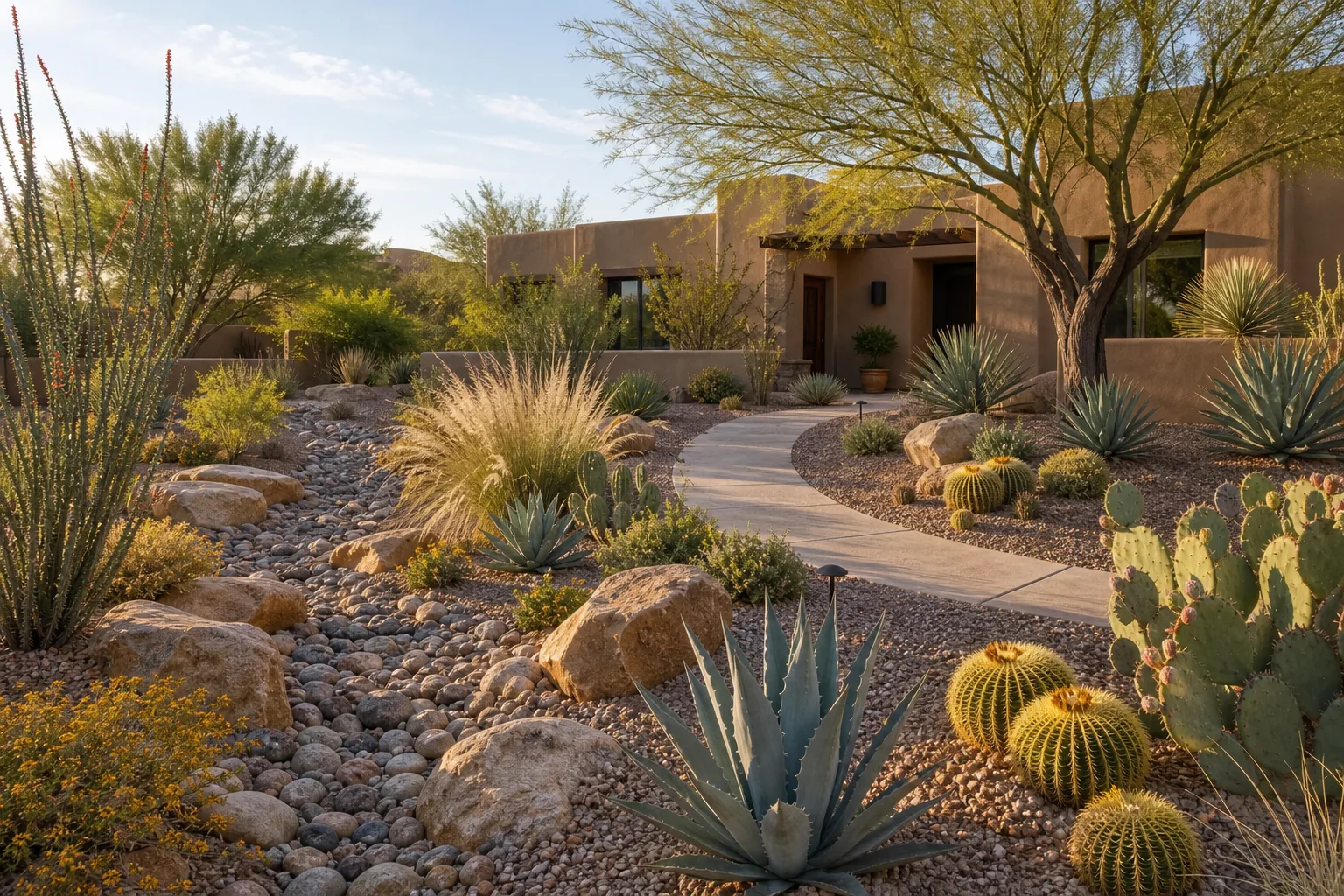
Xeriscaping is water-conscious landscape design using appropriate plants, efficient irrigation, useful turf only where it serves a purpose, mulch, good planning, and ongoing maintenance. It is not simply covering a yard with rock.
What is the difference between xeriscaping and zeroscaping?
Xeriscaping uses living, climate-appropriate plants and efficient water management. The informal term zeroscaping often describes mostly rock or bare hard surfaces, which can provide little shade or habitat and may increase reflected and stored heat.
Can grass be converted to a low-water desert landscape?
Yes. A complete conversion may include grass removal, grading, irrigation conversion, low-water plants, shade, mulch or decorative rock, borders, and drainage adjustments. Existing trees need protected roots and a continued water source.
Does Mesa offer a grass-to-xeriscape incentive?
Mesa currently advertises a residential future-project incentive of up to $2,100 for qualifying Mesa water customers. The owner must apply and receive a pre-inspection and notice to proceed before removing grass; funding and requirements can change, so verify the live program.
Does artificial turf qualify for Mesa's xeriscape incentive?
Artificial turf may be included, but it cannot replace the living-plant requirement. Mesa's current program requires qualifying low-water plants to provide at least 50 percent mature canopy coverage in the converted area, and approval is required before work begins.
Which low-water plants work well in Mesa?
Good candidates are selected from the current Phoenix-area low-water plant list and then matched to sun, reflected heat, soil, drainage, mature size, thorns, litter, and purpose. Desert willow, palo verde, red yucca, brittlebush, chuparosa, and selected agaves are examples, not a universal prescription.
When is the best time to plant trees and shrubs in Mesa?
Fall is especially favorable because soil stays warm while air temperatures and water demand decline. Early spring can also work; peak summer planting creates additional establishment stress and requires closer irrigation monitoring.
Can a xeriscape yard still provide shade and color?
Yes. Desert-adapted shade trees, flowering shrubs, groundcovers, accents, and seasonal bloom can create a layered yard with much more function than rock alone. Plan for mature canopy so plants are not crowded at installation.
Is decorative rock or organic mulch better?
Both can reduce evaporation and bare-soil dust. Rock is durable but stores heat; organic mulch can moderate soil temperature and improve the surface as it breaks down but needs replenishment. Keep any mulch a few inches away from trunks and stems.
Does landscape fabric stop weeds permanently?
No. Proper removal and preparation reduce the initial weed load, but windblown seed can germinate in dust above fabric and weeds can enter at openings or edges. Permeability, plant growth, future repairs, and Mesa rebate rules should be considered before choosing an underlayment.
How much maintenance does desert landscaping need?
Less water does not mean no care. Expect irrigation checks, selective pruning, seasonal weeds, debris removal, occasional rock or mulch touch-up, and adjustments as plants mature; avoiding constant shrub shearing usually supports a healthier natural form.
What grass performs best in Mesa's summer heat?
Bermudagrass is the best-adapted conventional turfgrass for Arizona's low desert. It grows actively in warm months and normally becomes tan and dormant after cold weather, so a winter-brown Bermuda lawn is not necessarily dead.
Why does Bermuda grass turn brown in winter?
Bermuda is a warm-season grass and enters dormancy after frost or sustained cold. It normally greens again as soil and air temperatures rise, provided the lawn and irrigation are otherwise healthy.
Should I overseed Bermuda with winter ryegrass?
Overseeding is optional. Rye provides winter green but needs germination water, mowing, fertilizer, and a managed spring transition; leaving Bermuda dormant saves water and labor and can support stronger summer recovery.
When should winter ryegrass be planted in Mesa?
University of Arizona guidance identifies October conditions--roughly 80 to 85 degree days and nights near 55 degrees--as favorable. Planting too early favors Bermuda, while planting too late increases cold risk for young rye seedlings.
Should a new Bermuda lawn be overseeded in its first winter?
Usually not. University of Arizona guidance recommends allowing a new Bermuda lawn a full warm season to build vigorous roots before making it compete with winter ryegrass.
Is sod or seed better for a new Mesa lawn?
Sod creates usable coverage faster and reduces the exposed-soil period, while seed can cost less for compatible grass varieties but takes longer and needs careful establishment watering. Site preparation, grade, irrigation coverage, timing, and the desired Bermuda type matter.
Why does my Mesa lawn have dry or brown patches?
Common causes include uneven sprinkler coverage, compacted or shallow soil, shade, runoff, clogged heads, pet use, mowing stress, pests, disease, or seasonal transition. The shape and timing of the patch help determine what to inspect first.
How often should Bermuda grass be watered in summer?
Mesa advises that even during the hottest months Bermuda generally should not need water more often than once every three days. Apply enough to wet the root zone, use cycle-and-soak if runoff begins, and adjust for actual soil and system output.
How often should Bermuda grass be mowed?
During active summer growth it commonly needs mowing at least weekly, depending on variety and chosen height. Use a sharp blade and avoid removing more than about one-third of the leaf height in a single mowing.
When should a Mesa lawn be fertilized, aerated, or dethatched?
These jobs should occur while the target grass is actively growing and should match its condition, not a one-size calendar. Too much fertilizer or aggressive cultivation at the wrong time can increase stress, water use, disease, or recovery time.
How much does artificial turf cost in Mesa?
Installed turf is normally priced from measured area plus demolition, haul-away, access, grade correction, base preparation, drainage, edge detail, turf product, infill, and site complexity. Small or irregular projects may have minimum costs, so compare complete written scopes rather than turf price alone.
Does artificial turf get hot in Mesa?
Yes. Artificial turf can become dangerously hot in direct summer sun, especially for bare feet and paws. Shade, living plants, intended use, surrounding materials, and time of day should be part of the decision; rinsing cools it only temporarily.
Is artificial turf maintenance-free?
No. It avoids mowing and routine lawn irrigation but still needs leaf and debris removal, brushing, edge inspection, weed control, spot cleaning, and periodic rinsing, especially where pets use it.
Can artificial turf work for dogs?
Yes, when the plan accounts for permeable backing, a draining base, secure seams and edges, suitable infill, and an ongoing cleaning routine. Shade and surface-temperature checks are essential before allowing pets onto turf in hot weather.
How do you prevent pet odors in artificial turf?
Odor control begins with drainage and a base that does not trap liquids. Remove solid waste promptly, rinse affected areas, use products intended for synthetic turf, and address recurring low spots or clogged drainage instead of masking the smell.
How is drainage handled under artificial turf?
The surrounding grade, soil, runoff volume, base material, compaction, turf backing, and discharge route all matter. Turf should not direct monsoon water toward the home, pool equipment, walls, or neighboring property.
Can weeds grow through artificial turf?
Professional removal and base preparation reduce weeds, but windblown seed can germinate in dust on top and growth can appear at edges, seams, drains, or penetrations. Occasional weed maintenance is still realistic.
How long does artificial turf last in Arizona?
Service life varies with product quality, ultraviolet exposure, heat, traffic, pets, drainage, installation, and maintenance. Review the manufacturer's product warranty and the installer's workmanship coverage separately, including exclusions and transfer rules.
Can artificial turf be installed around pools, trees, or pavers?
Often, but each transition needs secure edges and drainage. Retained trees need protected roots and continued irrigation, while pool areas require attention to surface heat, wet traction, splash, chemicals, deck elevations, and equipment access.
Can artificial turf be installed over concrete or on a slope?
Sometimes, if the surface drains correctly and the system includes suitable attachment and cushioning details. Slopes require secure anchoring and erosion control; covering a drainage or structural problem with turf does not solve it.
How much do pavers cost in Mesa?
Cost depends on measured area, demolition, excavation, access, base design, compaction, drainage, paver selection, pattern, cuts, borders, edge restraint, steps, and disposal. Driveways and small detailed areas can cost more per square foot than a simple open patio.
Are pavers better than poured concrete?
Pavers offer pattern options and can often be lifted for localized repairs, while poured concrete creates a continuous surface with fewer joints. The better choice depends on appearance, load, drainage, heat, maintenance, budget, and how future utility access will be handled.
Why is base preparation important under pavers?
The base distributes loads and helps the finished surface resist settlement and movement. Soil conditions, expected traffic, drainage, and the paver system determine excavation and base requirements; there is no responsible universal depth for every Mesa property.
How do pavers account for yard drainage?
Finished elevation and slope should be planned around thresholds, stucco clearances, pool decks, downspouts, low areas, and the legal discharge route. New hardscape should not send runoff toward a structure or neighboring property.
Are driveway pavers different from patio pavers?
Driveways carry vehicle loads and need an appropriate paver thickness, pattern, base, compaction, and edge restraint. A product or base detail suited to foot traffic should not automatically be assumed suitable for vehicles.
Can settled or damaged pavers be repaired?
Often, yes. Individual pavers can be lifted so the failed base, irrigation leak, root issue, or edge movement can be corrected before reinstallation. Repairing only the visible surface without fixing the cause invites the problem to return.
Why do weeds grow between pavers?
Many paver weeds germinate from windblown seed and organic matter collected in the joints, not from deep roots below the base. Keeping joints filled appropriately and removing debris reduces growth, but no outdoor joint system is permanently weed-free.
What is the white residue on new pavers?
It may be efflorescence, a mineral deposit that can appear as moisture carries salts to the surface. Confirm the cause before cleaning, follow the paver manufacturer's instructions, and test any cleaner in an inconspicuous area.
Should pavers be sealed in Arizona?
Sealing is optional and depends on the product, desired color, stain exposure, joint system, and maintenance plan. A sealer can change appearance or traction, so use a compatible product only after the pavers are ready and test the finish first.
Do pavers get hot around a Mesa pool?
Yes, many hardscape materials become uncomfortable in direct sun. Compare actual samples in similar sun, consider lighter colors and shade, and select a pool-area surface for wet traction as well as heat and appearance.
Does a retaining wall require a permit in Mesa?
Permit requirements depend on height, whether the wall retains soil or water, added loads, location, and site conditions. Mesa's limited under-four-foot exception has specific conditions, so confirm the actual wall with Development Services instead of relying on height alone.
What is the difference between a retaining wall and a decorative wall?
A retaining wall resists soil and water pressure created by a grade difference. A decorative or freestanding garden wall may define space without carrying that load, so its foundation, drainage, engineering, and permit needs can differ.
Does every retaining wall need drainage?
A wall that retains soil generally needs a way to manage water pressure, but the correct system depends on the wall, soil, grade, irrigation, and runoff. Drain rock, filter fabric, outlets, and reinforcement must work as one design.
When does a retaining wall need an engineer?
Engineering may be required because of wall height, slope, surcharge loads, poor soil, nearby structures, pools, property lines, or local code. Cracking, leaning, bulging, or repeated movement also warrants qualified evaluation before cosmetic repair.
Can a retaining wall include seating or a planter?
Often, if the structural design, cap dimensions, drainage, waterproofing, irrigation, and adjacent surfaces support the added function. A planter or seat should not trap water or create loads the wall was not designed to carry.
Why does water pool in my Mesa yard after monsoon rain?
Common causes include low grading, compacted soil, blocked drains, undersized outlets, downspout discharge, new hardscape, or runoff entering from another area. A safe photograph during or soon after a storm can add useful context about the drainage path after the water recedes. Never enter moving water or an unsafe area to take a photo.
Can grading fix water near my foundation?
Sometimes, but the entire drainage route must be understood before moving soil. The solution may involve grading, swales, catch basins, downspout changes, or another outlet, and substantial work may require plans or approval.
What is the difference between a swale, catch basin, French drain, and dry creek?
A swale moves surface water, a catch basin collects it into piping, a French drain manages subsurface water through aggregate and pipe, and a dry creek is a surface feature that can convey runoff. The site needs a lawful, workable discharge or infiltration plan.
Can landscaping send water onto a neighboring property?
It should not. New grading and hardscape should preserve safe drainage and avoid concentrating runoff onto a neighbor, street, wall, or structure. Property-line drainage disputes may require a survey, engineer, HOA, or municipal guidance.
Which shade trees are good for a Mesa yard?
Choose a native or desert-adapted tree whose mature canopy and roots fit the space. Consider shade direction, litter, thorns, water needs, reflected heat, buildings, walls, pools, overhead lines, and underground utilities before choosing a species.
When is the best time to plant a tree in Mesa?
Fall is especially favorable, and early spring can also work, because the tree can establish before the most intense summer conditions. Planting in peak heat requires closer irrigation monitoring and adds avoidable stress.
How should a new tree be watered?
Wet the root ball and some surrounding soil so roots grow outward, then adjust frequency as the tree establishes. Do not keep the trunk constantly wet, and verify moisture depth rather than assuming a short drip run is enough.
Where should an established tree be watered?
Water over a broad area near and beyond the canopy drip line, where many absorbing roots are active, rather than only beside the trunk. Move or add emitters as the canopy expands and water deeply at wider intervals.
How long should a newly planted tree stay staked?
Stake only when the tree cannot stand securely on its own, allow slight trunk movement, and inspect ties for damage. City of Mesa and University of Arizona guidance generally calls for removal after the first growing season or about one year.
Should mulch touch a tree trunk?
No. Mulch over the root zone helps retain moisture and moderate soil temperature, but keep it several inches away from the trunk to reduce trapped moisture, rot, and pest problems.
Should a newly planted tree be pruned right away?
Limit early pruning to broken or clearly damaged branches unless a qualified professional identifies a structural need. The young tree needs foliage to establish roots, and corrective training can continue as it grows.
Should trees be heavily thinned before monsoon season?
No. Remove dead, broken, crossing, or structurally weak growth selectively, but excessive thinning and topping can expose bark, reduce energy production, and create weak regrowth. Tree stability also depends on roots, soil, irrigation, species, and defects.
When should a certified arborist inspect a tree?
Use a qualified arborist for hazardous limbs, split trunks, disease diagnosis, mature-tree structure, storm damage, large removals, root conflicts, or work requiring climbing. Never approach a tree or branch contacting a power line.
How should palm trees be trimmed in Arizona?
Remove dead brown fronds and unwanted flower or fruit stalks, but avoid stripping healthy green fronds above the horizontal line. Over-pruning weakens palms, and tall palm work should be handled with proper equipment rather than climbing spikes on a live tree.
What should I do with a neighbor's tree over my yard?
Start with a respectful conversation and identify the property line and any HOA responsibility. Avoid cuts that could destabilize or seriously damage the tree; significant conflicts may require an arborist, survey, HOA, or legal guidance.
Official resources
Check current Mesa and Arizona requirements.
Use these government and utility sources to verify incentive eligibility, water guidance, permits, right-of-way rules, tree care, contractor records, and utility marking before work begins.
Resources rechecked August 11, 2026. Program funding, eligibility, municipal rules, and agency guidance can change.
- City of Mesa grass-to-xeriscape incentive eligibility and rules
- City of Mesa outdoor water conservation and irrigation guidance
- City of Mesa Development Services and permit information
- City of Mesa residential construction and retaining-wall FAQ
- City of Mesa right-of-way management guidance
- City of Mesa tree selection, planting, watering, and maintenance guidance
- Arizona Department of Water Resources landscaping guidance
- Arizona Registrar of Contractors license lookup and hiring guidance
- Arizona 811 utility-marking information before digging
Still deciding?
Ask your landscaping question.
Call, text, or email to discuss a project without photos. For a free online quote, use the project form and attach clear, current project photos before sending the Gmail draft.